 Add to Chrome
 Add to Firefox
 Add to Edge
Knowledge-Augmented Large Language Model Agents for Explainable Financial Decision-Making
Dec 10, 2025
This study investigates an explainable reasoning method for financial decision-making based on knowledge-enhanced large language model agents. To address the limitations of traditional financial decision methods that rely on parameterized knowledge, lack factual consistency, and miss reasoning chains, an integrated framework is proposed that combines external knowledge retrieval, semantic representation, and reasoning generation. The method first encodes financial texts and structured data to obtain semantic representations, and then retrieves task-related information from external knowledge bases using similarity computation. Internal representations and external knowledge are combined through weighted fusion, which ensures fluency while improving factual accuracy and completeness of generated content. In the reasoning stage, a multi-head attention mechanism is introduced to construct logical chains, allowing the model to present transparent causal relationships and traceability during generation. Finally, the model jointly optimizes task objectives and explanation consistency objectives, which enhances predictive performance and reasoning interpretability. Experiments on financial text processing and decision tasks show that the method outperforms baseline approaches in accuracy, text generation quality, and factual support, verifying the effectiveness of knowledge enhancement and explainable reasoning. Overall, the proposed approach overcomes the limitations of traditional models in semantic coverage and reasoning transparency, and demonstrates strong practical value in complex financial scenarios.

Multi-Scale Feature Fusion and Graph Neural Network Integration for Text Classification with Large Language Models
Nov 07, 2025This study investigates a hybrid method for text classification that integrates deep feature extraction from large language models, multi-scale fusion through feature pyramids, and structured modeling with graph neural networks to enhance performance in complex semantic contexts. First, the large language model captures contextual dependencies and deep semantic representations of the input text, providing a rich feature foundation for subsequent modeling. Then, based on multi-level feature representations, the feature pyramid mechanism effectively integrates semantic features of different scales, balancing global information and local details to construct hierarchical semantic expressions. Furthermore, the fused features are transformed into graph representations, and graph neural networks are employed to capture latent semantic relations and logical dependencies in the text, enabling comprehensive modeling of complex interactions among semantic units. On this basis, the readout and classification modules generate the final category predictions. The proposed method demonstrates significant advantages in robustness alignment experiments, outperforming existing models on ACC, F1-Score, AUC, and Precision, which verifies the effectiveness and stability of the framework. This study not only constructs an integrated framework that balances global and local information as well as semantics and structure, but also provides a new perspective for multi-scale feature fusion and structured semantic modeling in text classification tasks.
TimeHF: Billion-Scale Time Series Models Guided by Human Feedback
Jan 27, 2025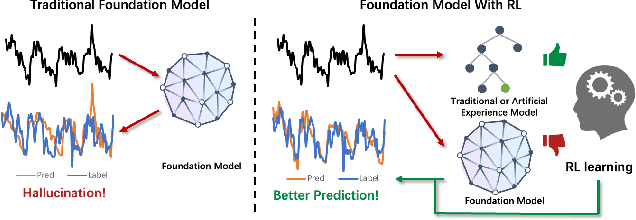
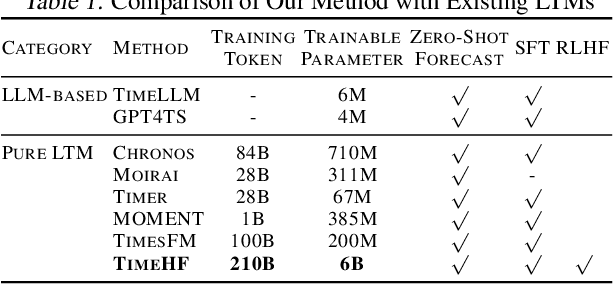

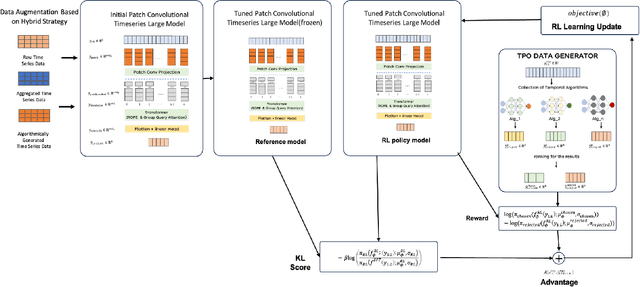
Time series neural networks perform exceptionally well in real-world applications but encounter challenges such as limited scalability, poor generalization, and suboptimal zero-shot performance. Inspired by large language models, there is interest in developing large time series models (LTM) to address these issues. However, current methods struggle with training complexity, adapting human feedback, and achieving high predictive accuracy. We introduce TimeHF, a novel pipeline for creating LTMs with 6 billion parameters, incorporating human feedback. We use patch convolutional embedding to capture long time series information and design a human feedback mechanism called time-series policy optimization. Deployed in JD.com's supply chain, TimeHF handles automated replenishment for over 20,000 products, improving prediction accuracy by 33.21% over existing methods. This work advances LTM technology and shows significant industrial benefits.
sTransformer: A Modular Approach for Extracting Inter-Sequential and Temporal Information for Time-Series Forecasting
Aug 19, 2024In recent years, numerous Transformer-based models have been applied to long-term time-series forecasting (LTSF) tasks. However, recent studies with linear models have questioned their effectiveness, demonstrating that simple linear layers can outperform sophisticated Transformer-based models. In this work, we review and categorize existing Transformer-based models into two main types: (1) modifications to the model structure and (2) modifications to the input data. The former offers scalability but falls short in capturing inter-sequential information, while the latter preprocesses time-series data but is challenging to use as a scalable module. We propose $\textbf{sTransformer}$, which introduces the Sequence and Temporal Convolutional Network (STCN) to fully capture both sequential and temporal information. Additionally, we introduce a Sequence-guided Mask Attention mechanism to capture global feature information. Our approach ensures the capture of inter-sequential information while maintaining module scalability. We compare our model with linear models and existing forecasting models on long-term time-series forecasting, achieving new state-of-the-art results. We also conducted experiments on other time-series tasks, achieving strong performance. These demonstrate that Transformer-based structures remain effective and our model can serve as a viable baseline for time-series tasks.
SAR ATR Method with Limited Training Data via an Embedded Feature Augmenter and Dynamic Hierarchical-Feature Refiner
Sep 01, 2023Without sufficient data, the quantity of information available for supervised training is constrained, as obtaining sufficient synthetic aperture radar (SAR) training data in practice is frequently challenging. Therefore, current SAR automatic target recognition (ATR) algorithms perform poorly with limited training data availability, resulting in a critical need to increase SAR ATR performance. In this study, a new method to improve SAR ATR when training data are limited is proposed. First, an embedded feature augmenter is designed to enhance the extracted virtual features located far away from the class center. Based on the relative distribution of the features, the algorithm pulls the corresponding virtual features with different strengths toward the corresponding class center. The designed augmenter increases the amount of information available for supervised training and improves the separability of the extracted features. Second, a dynamic hierarchical-feature refiner is proposed to capture the discriminative local features of the samples. Through dynamically generated kernels, the proposed refiner integrates the discriminative local features of different dimensions into the global features, further enhancing the inner-class compactness and inter-class separability of the extracted features. The proposed method not only increases the amount of information available for supervised training but also extracts the discriminative features from the samples, resulting in superior ATR performance in problems with limited SAR training data. Experimental results on the moving and stationary target acquisition and recognition (MSTAR), OpenSARShip, and FUSAR-Ship benchmark datasets demonstrate the robustness and outstanding ATR performance of the proposed method in response to limited SAR training data.
Semi-Supervised SAR ATR Framework with Transductive Auxiliary Segmentation
Aug 31, 2023Convolutional neural networks (CNNs) have achieved high performance in synthetic aperture radar (SAR) automatic target recognition (ATR). However, the performance of CNNs depends heavily on a large amount of training data. The insufficiency of labeled training SAR images limits the recognition performance and even invalidates some ATR methods. Furthermore, under few labeled training data, many existing CNNs are even ineffective. To address these challenges, we propose a Semi-supervised SAR ATR Framework with transductive Auxiliary Segmentation (SFAS). The proposed framework focuses on exploiting the transductive generalization on available unlabeled samples with an auxiliary loss serving as a regularizer. Through auxiliary segmentation of unlabeled SAR samples and information residue loss (IRL) in training, the framework can employ the proposed training loop process and gradually exploit the information compilation of recognition and segmentation to construct a helpful inductive bias and achieve high performance. Experiments conducted on the MSTAR dataset have shown the effectiveness of our proposed SFAS for few-shot learning. The recognition performance of 94.18\% can be achieved under 20 training samples in each class with simultaneous accurate segmentation results. Facing variances of EOCs, the recognition ratios are higher than 88.00\% when 10 training samples each class.
Crucial Feature Capture and Discrimination for Limited Training Data SAR ATR
Aug 20, 2023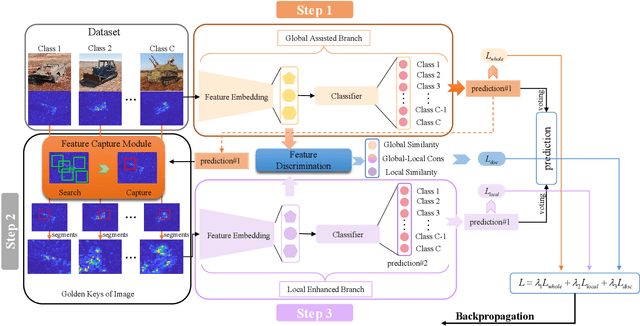
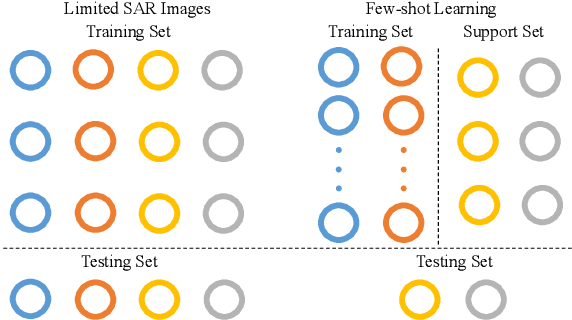
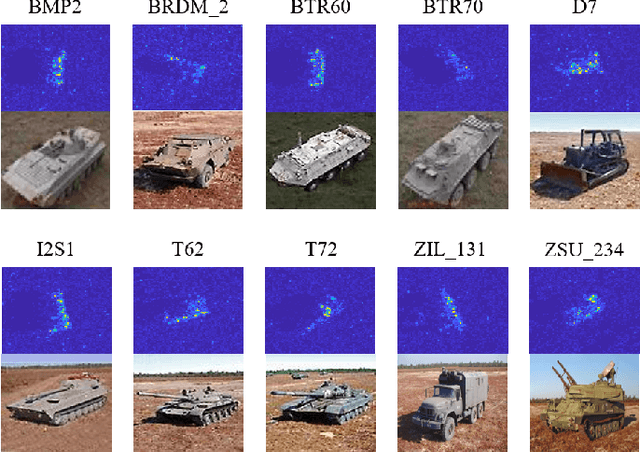
Although deep learning-based methods have achieved excellent performance on SAR ATR, the fact that it is difficult to acquire and label a lot of SAR images makes these methods, which originally performed well, perform weakly. This may be because most of them consider the whole target images as input, but the researches find that, under limited training data, the deep learning model can't capture discriminative image regions in the whole images, rather focus on more useless even harmful image regions for recognition. Therefore, the results are not satisfactory. In this paper, we design a SAR ATR framework under limited training samples, which mainly consists of two branches and two modules, global assisted branch and local enhanced branch, feature capture module and feature discrimination module. In every training process, the global assisted branch first finishes the initial recognition based on the whole image. Based on the initial recognition results, the feature capture module automatically searches and locks the crucial image regions for correct recognition, which we named as the golden key of image. Then the local extract the local features from the captured crucial image regions. Finally, the overall features and local features are input into the classifier and dynamically weighted using the learnable voting parameters to collaboratively complete the final recognition under limited training samples. The model soundness experiments demonstrate the effectiveness of our method through the improvement of feature distribution and recognition probability. The experimental results and comparisons on MSTAR and OPENSAR show that our method has achieved superior recognition performance.
SAR Ship Target Recognition Via Multi-Scale Feature Attention and Adaptive-Weighed Classifier
Aug 20, 2023
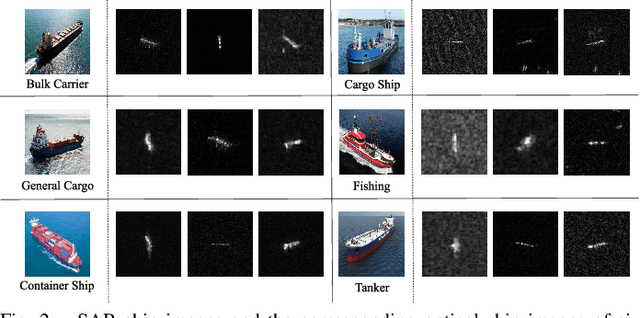
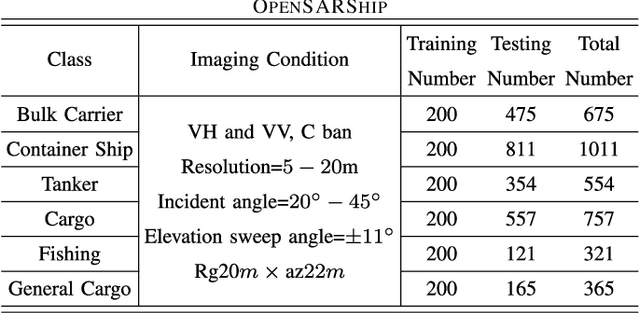
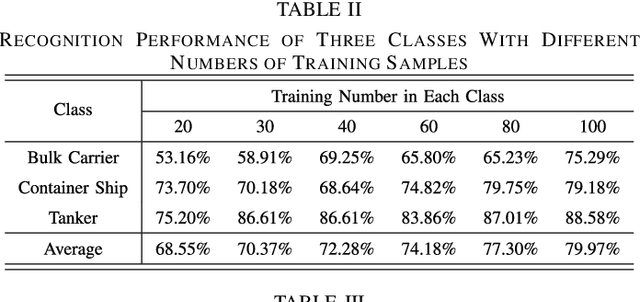
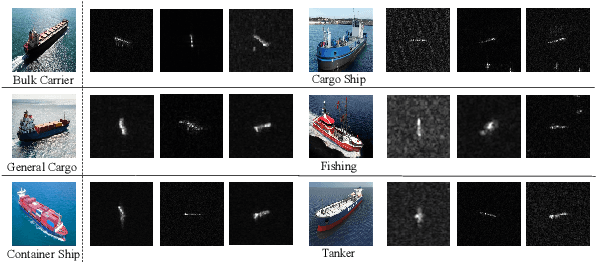
Maritime surveillance is indispensable for civilian fields, including national maritime safeguarding, channel monitoring, and so on, in which synthetic aperture radar (SAR) ship target recognition is a crucial research field. The core problem to realizing accurate SAR ship target recognition is the large inner-class variance and inter-class overlap of SAR ship features, which limits the recognition performance. Most existing methods plainly extract multi-scale features of the network and utilize equally each feature scale in the classification stage. However, the shallow multi-scale features are not discriminative enough, and each scale feature is not equally effective for recognition. These factors lead to the limitation of recognition performance. Therefore, we proposed a SAR ship recognition method via multi-scale feature attention and adaptive-weighted classifier to enhance features in each scale, and adaptively choose the effective feature scale for accurate recognition. We first construct an in-network feature pyramid to extract multi-scale features from SAR ship images. Then, the multi-scale feature attention can extract and enhance the principal components from the multi-scale features with more inner-class compactness and inter-class separability. Finally, the adaptive weighted classifier chooses the effective feature scales in the feature pyramid to achieve the final precise recognition. Through experiments and comparisons under OpenSARship data set, the proposed method is validated to achieve state-of-the-art performance for SAR ship recognition.
An Entropy-Awareness Meta-Learning Method for SAR Open-Set ATR
Aug 20, 2023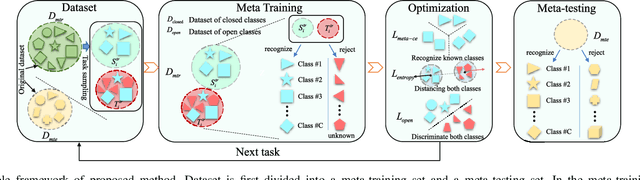
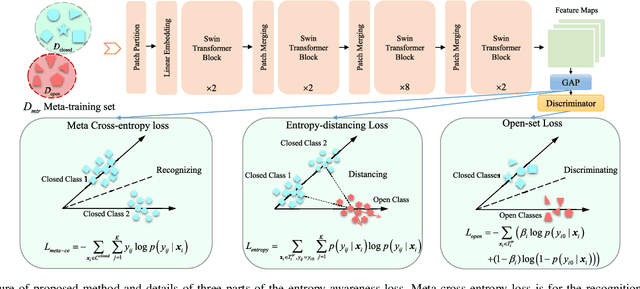
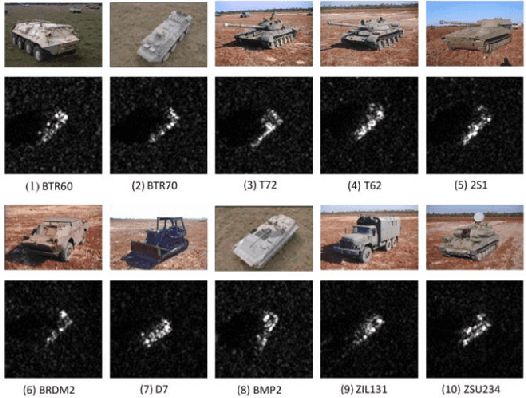
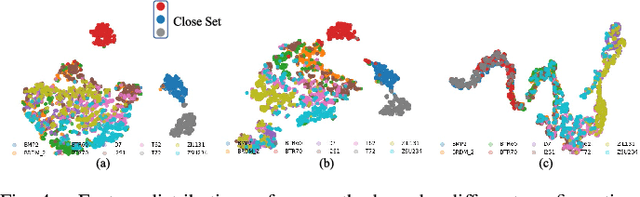
Existing synthetic aperture radar automatic target recognition (SAR ATR) methods have been effective for the classification of seen target classes. However, it is more meaningful and challenging to distinguish the unseen target classes, i.e., open set recognition (OSR) problem, which is an urgent problem for the practical SAR ATR. The key solution of OSR is to effectively establish the exclusiveness of feature distribution of known classes. In this letter, we propose an entropy-awareness meta-learning method that improves the exclusiveness of feature distribution of known classes which means our method is effective for not only classifying the seen classes but also encountering the unseen other classes. Through meta-learning tasks, the proposed method learns to construct a feature space of the dynamic-assigned known classes. This feature space is required by the tasks to reject all other classes not belonging to the known classes. At the same time, the proposed entropy-awareness loss helps the model to enhance the feature space with effective and robust discrimination between the known and unknown classes. Therefore, our method can construct a dynamic feature space with discrimination between the known and unknown classes to simultaneously classify the dynamic-assigned known classes and reject the unknown classes. Experiments conducted on the moving and stationary target acquisition and recognition (MSTAR) dataset have shown the effectiveness of our method for SAR OSR.
SAR Ship Target Recognition via Selective Feature Discrimination and Multifeature Center Classifier
Aug 20, 2023Maritime surveillance is not only necessary for every country, such as in maritime safeguarding and fishing controls, but also plays an essential role in international fields, such as in rescue support and illegal immigration control. Most of the existing automatic target recognition (ATR) methods directly send the extracted whole features of SAR ships into one classifier. The classifiers of most methods only assign one feature center to each class. However, the characteristics of SAR ship images, large inner-class variance, and small interclass difference lead to the whole features containing useless partial features and a single feature center for each class in the classifier failing with large inner-class variance. We proposes a SAR ship target recognition method via selective feature discrimination and multifeature center classifier. The selective feature discrimination automatically finds the similar partial features from the most similar interclass image pairs and the dissimilar partial features from the most dissimilar inner-class image pairs. It then provides a loss to enhance these partial features with more interclass separability. Motivated by divide and conquer, the multifeature center classifier assigns multiple learnable feature centers for each ship class. In this way, the multifeature centers divide the large inner-class variance into several smaller variances and conquered by combining all feature centers of one ship class. Finally, the probability distribution over all feature centers is considered comprehensively to achieve an accurate recognition of SAR ship images. The ablation experiments and experimental results on OpenSARShip and FUSAR-Ship datasets show that our method has achieved superior recognition performance under decreasing training SAR ship samples.